
Treat injuries. Run faster.
Move better.
Advanced 3D gait analysis giving you a detailed, objective picture of how your body moves when you run.
Whether you’re struggling with an injury, experiencing a recurring niggle or looking to improve your running performance, Run3D allows us to look beyond what we can see with the naked eye and objectively measure your movement in three dimensions.
Developed at the University of Oxford, Run3D uses advanced motion-capture technology to help our podiatrists understand your individual biomechanics and identify movement patterns and asymmetries that may be relevant to your pain, injury or performance.
“Like an MRI of how you move.”
What is Run3D?
Run3D is a specialist 3D gait analysis system developed by scientists at the University of Oxford.
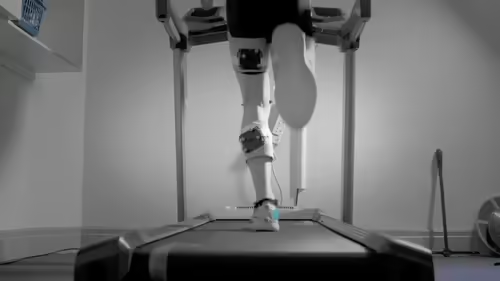
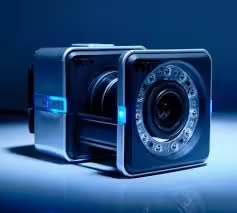
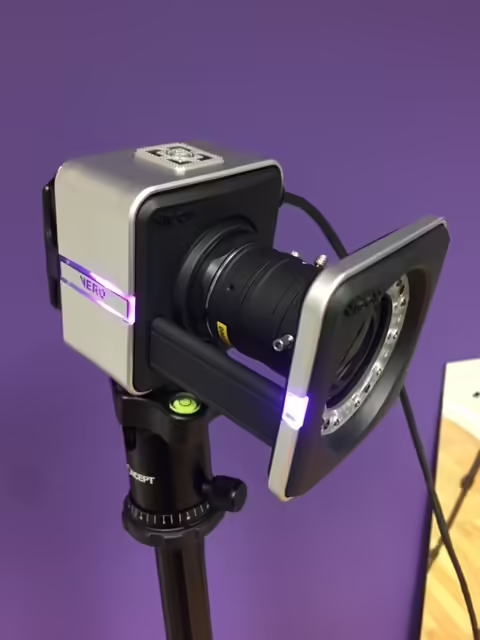
Unlike conventional gait analysis that relies primarily on video and visual observation, Run3D uses specialist infrared cameras and reflective markers to accurately measure the way your body moves.
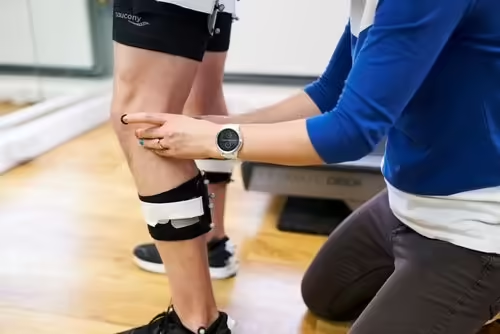
Small reflective markers are positioned on specific anatomical points on your legs and shoes. As you run, the cameras track the position of these markers to create an accurate 3D model of your lower body.
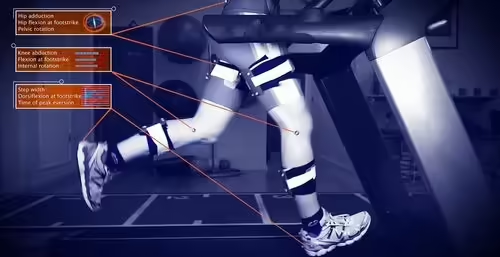
This allows us to precisely measure movement through your:
- Pelvis
- Hips
- Knees
- Ankles
Importantly, Run3D measures these joints across all three planes of human movement, giving us information that can’t be accurately captured through conventional 2D video alone.
Your Movement. Measured.
39
Reflective markers
Positioned on specific anatomical landmarks on your legs and shoes.
200×
Measurements every second
3D
Motion analysis
4
Key areas analysed
- Pelvis
- Hips
- Knees
- Ankles
Run3D’s patient information specifies 39 markers and explains that its motion-capture cameras measure marker positions 200 times per second.
Why Does 3D Matter?
Because your body doesn't move in 2D.
Running is a complex sequence of movements and rotations.
When your knee bends, for example, it doesn’t simply move backwards and forwards. It can simultaneously rotate and move towards or away from the other leg.
To properly understand your biomechanics, we need to be able to measure these different movements.
Traditional video-based gait assessments capture movement in two dimensions and can be useful for visually assessing your running technique. However, they don’t objectively measure all of the rotational movements occurring throughout your body.
Run3D measures your movement in three dimensions.
This allows us to investigate subtle movement patterns and asymmetries that may otherwise be difficult to identify.
Who is Run3D For?
You don’t have to be an elite athlete — or even currently injured — to benefit from understanding how you move.
Run3D may be useful for:
- Runners experiencing pain or injury
- Persistent niggles or recurring injuries
- New runners
- Runners looking to increase their training volume
- High-mileage runners
- Runners looking to improve their performance
- Triathletes
- Anyone wanting a deeper understanding of their running biomechanics
Run3D describes the system as suitable for people of different ages and abilities and for applications including musculoskeletal pain, screening, injury prevention and performance.
What Can Run3D Help With?
Running injuries can be complex. The area that hurts isn’t necessarily the only area we need to investigate.
Run3D allows us to objectively assess movement throughout the lower body and identify biomechanical factors that may be relevant to your symptoms.
It may be useful when assessing:
Hip & Upper Leg
- Lower back pain
- Hip pain
- Greater trochanteric bursitis
- Piriformis syndrome
- Hip osteoarthritis
- Hamstring tendinopathy
- Adductor / groin pain
Knee
- Patellofemoral pain
- Iliotibial band syndrome (ITBS)
- Patellar tendinopathy
- Meniscal injuries
- Knee osteoarthritis
Lower Leg
- Medial tibial stress syndrome / shin splints
- Recurring calf strains
- Persistent calf tightness
Foot & Ankle
- Achilles tendinopathy
- Tibialis posterior tendinopathy / dysfunction
- Plantar fasciitis
What Happens During Your Run3D Assessment?
01. We Start With You
Before looking at the data, we need to understand you.
We’ll discuss your symptoms, injury history, running and training, previous treatment and what you would like to achieve from your assessment.
This gives your podiatrist the context needed to interpret your Run3D results properly.
02. Marker Set-Up
We’ll attach 39 small reflective markers to specific anatomical landmarks on your legs and shoes.
Marker set-up takes approximately 5–10 minutes.
Shorts are ideal for your assessment as we need access to specific anatomical points on your legs.
03. Run3D Motion Capture
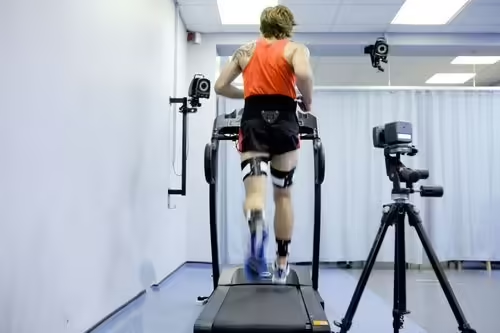
You’ll then get onto the treadmill and walk and/or run at a speed that’s comfortable for you.
Once you’re settled, we’ll begin capturing your gait.
Our infrared cameras detect the reflective markers and measure their position 200 times every second, allowing Run3D to create a detailed 3D representation of your movement.
Depending on what we’re investigating, your podiatrist may also record you at different speeds or in different footwear.
04. Your Gait is Analysed
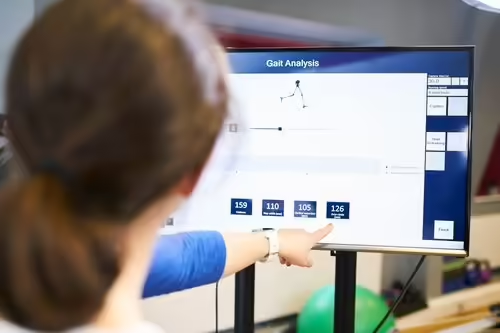
Run3D captures a huge amount of information about your gait and biomechanics.
Your podiatrist will review your results alongside your clinical history and symptoms to identify movement patterns, asymmetries and other findings that may be relevant to your individual presentation.
Run3D’s system is designed to provide objective biomechanical measurements rather than relying solely on visual observation.
05. We Explain Your Results
We’ll take you through what we’ve found and, importantly, explain what the information means for you.
The aim isn’t to give you pages of numbers.
It’s to use the data alongside our clinical expertise to better understand your movement and determine what, if anything, we should address.
06. Your Individual Plan
There isn’t one standard recommendation after Run3D.
Your next steps will depend entirely on you, your symptoms and your results.
Recommendations could include:
- Exercise rehabilitation
- Strengthening
- Gait retraining
- Footwear advice
- Orthotics
- Podiatry treatment
- Further investigation
- Onward referral
Run3D’s patient information similarly lists rehabilitation, physiotherapy, gait retraining, footwear/orthotics and onward referral as potential recommendations following assessment.
More Than Just a Running Video
Run3D vs Traditional Video Gait Analysis
A traditional gait assessment can provide useful visual information about the way you run.
Run3D takes the assessment further by objectively measuring your movement in three dimensions.
Traditional Video Analysis
- Records movement in 2D
- Primarily relies on visual interpretation
- Doesn’t objectively measure all rotational movement
- Provides a visual representation of your running technique
Run3D
- Measures movement in 3D
- Uses specialist infrared motion-capture cameras
- Provides objective numerical data
- Measures movement and rotation through multiple joints
- Can identify differences between your left and right sides
- Allows changes to be objectively measured and compared
How Can Run3D Help Me?
Understand your injury
Running injuries are rarely as simple as looking at the area that hurts.
Run3D gives us objective information about your movement, helping your podiatrist investigate biomechanical factors that may be contributing to your symptoms.
Make treatment more targeted
Your results can help us make informed decisions about what should happen next rather than relying on observation alone.
Improve your running
You don’t need to be injured.
Run3D can also provide objective information about your running mechanics and highlight movement patterns that may be relevant to running efficiency and performance.
Track meaningful changes
Where appropriate, gait analysis can be repeated or performed under different conditions, allowing your clinician to objectively compare how you move.
Run3D describes using its measurements to identify areas requiring improvement and then create individualised, data-driven recommendations.
What Should I Bring?
To get the most from your Run3D assessment, please bring:
- Running shorts – the shorter the better, as markers need to be positioned on your thighs
- A comfortable top you can move in
- Socks
- Your usual running shoes
- Any other running shoes you’d specifically like us to assess
- Any insoles or orthotics you currently wear
You don’t need to worry about the cameras filming your body during the motion capture itself. The infrared system detects the reflective markers, which are what Run3D uses to calculate your movement.
Frequently Asked Questions
Do I need to be injured to have Run3D?
No.
Run3D isn’t limited to injured runners. It can also be used to objectively assess your biomechanics when you’re starting running, increasing your training volume or looking at performance.
I'm not an elite runner. Is it still suitable for me?
Absolutely.
You don’t need to run marathons or compete at a high level. Run3D describes its gait-analysis technology as suitable for people across a range of ages and abilities.
Do I need a referral?
No.
You can book your Run3D assessment directly with us. You don’t need to be referred by your GP, physiotherapist or another healthcare professional.
I'm already seeing a physiotherapist. Can I still book?
Yes.
Run3D can complement your existing treatment by providing additional objective information about your gait and biomechanics.
Where appropriate, the findings can be used alongside the care you’re already receiving.
Is this the same as the gait analysis I can get in a running shop?
No.
Running-shop gait analysis commonly uses standard video to look at your running movement in two dimensions.
Run3D uses reflective markers and infrared motion-capture cameras to measure your movement in three dimensions, including rotational movement that standard 2D video doesn’t objectively measure.
Do the infrared cameras film me?
The infrared motion-capture cameras detect the reflective markers placed on your body.
Run3D explains that the cameras measure the positions of these markers 200 times per second to calculate your movement.
Will I have to run really fast?
No.
You’ll walk and/or run at a speed that’s comfortable for you. Depending on what we’re investigating, your clinician may also assess different speeds or footwear.
Advanced Technology.
Clinical Expertise.
A Plan Built Around You.
Run3D gives us an incredibly detailed picture of how you move.
Our job is to work out what that information means for you.
By combining objective 3D gait data with your symptoms, history and our podiatrists’ clinical assessment, we can build a clearer picture of your biomechanics and use that information to guide your next steps.
Whether you’re trying to overcome a persistent running injury, understand a recurring problem or simply want to learn more about your running mechanics, Run3D gives us the data to look deeper.