Achilles Pain and Tendinopathy
A sore, stiff Achilles that warms up as you go and hurts again afterwards is the classic pattern. It's one of the most common running injuries we treat, and one of the most commonly mismanaged. Typical symptoms:- Pain and stiffness at the back of the heel or a few centimetres above it
- Worst first thing in the morning and when you start exercising
- Eases as you warm up, then returns worse that evening or the next day
- A tender, sometimes thickened lump on the tendon
- Pain going uphill, on stairs, or pushing off
Is it tendonitis or tendinopathy?
Most people arrive calling it Achilles tendonitis, and that's the term you'll see everywhere. Tendinopathy is the more accurate word, because in all but the earliest cases there's very little inflammation involved. It matters because it changes the treatment: anti-inflammatories and rest treat inflammation, and that's not what's usually going on.What is Achilles tendinopathy?
The Achilles is the strongest tendon in the body and takes several times your body weight with every running stride. Tendinopathy is what happens when the load going through it outstrips its ability to recover.The tendon's structure changes, it thickens, and it becomes painful under load. That's why rest and anti-inflammatories tend to settle it briefly, and then it returns the moment you go back to normal.
There are two kinds, and they're treated differently. Mid-portion tendinopathy sits a few centimetres above the heel bone. Insertional tendinopathy sits right where the tendon meets the heel, and doesn't tolerate the same exercises, which is why a generic programme off the internet often makes it worse.
What causes it?
- Doing more, faster: a jump in mileage, pace, hills or a new sport
- Coming back too quickly after a break
- Calf weakness, which leaves the tendon taking load it can't handle
- Reduced ankle movement
- Footwear with a sudden change of heel height
- Age, which slows how quickly a tendon recovers between sessions
Why come to us for Achilles pain
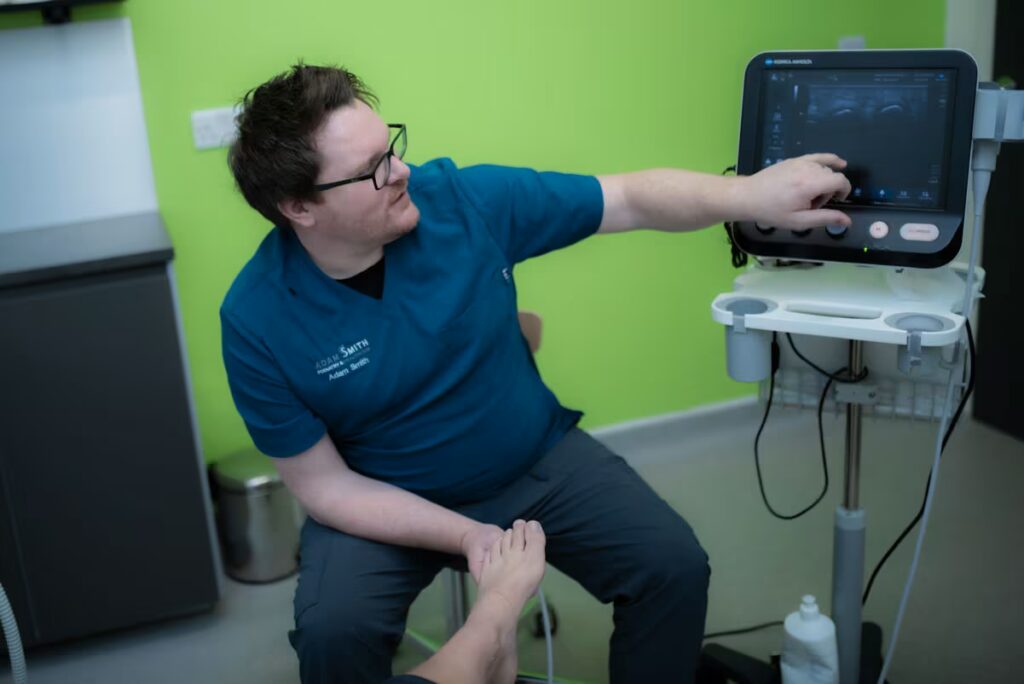
We scan it in clinic.
Ultrasound shows us the thickness of the tendon, where the problem actually sits, and whether there's any tearing. That changes the treatment.We tell the two types apart.
Insertional and mid-portion Achilles problems need different loading, and getting that wrong is the most common reason these don't get better.We have shockwave on site
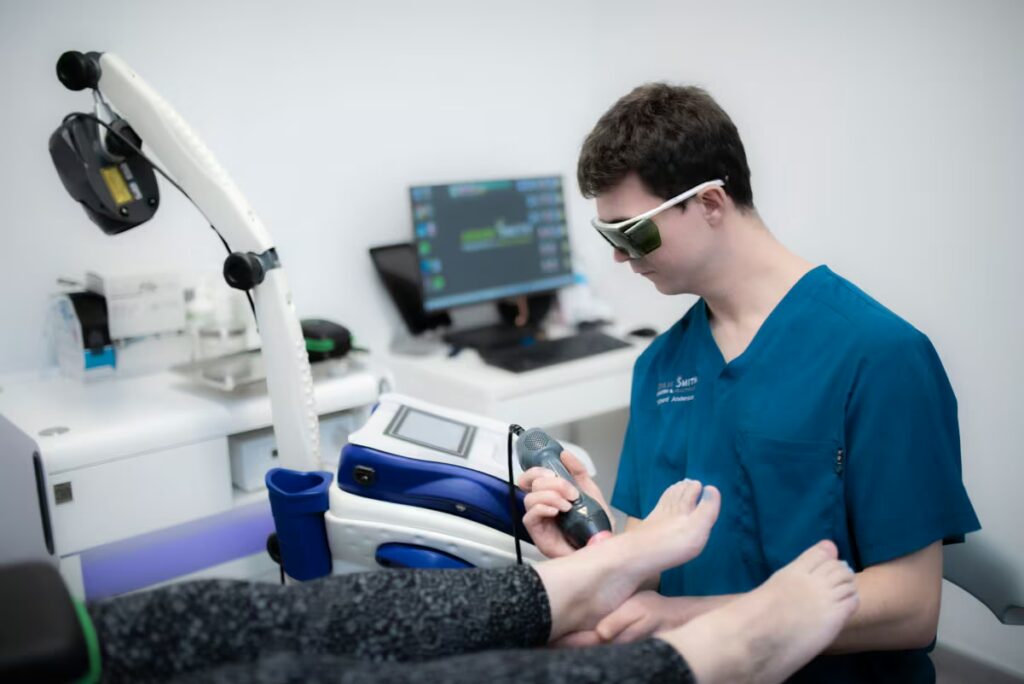
Which we use for Achilles tendinopathy that hasn't responded to loading alone. Every podiatrist on the team follows the same written Achilles shockwave standard.We assess how you run.
Run3D measures what your ankle and calf are actually doing at speed, not what they do standing still in a clinic room.We see a lot of it in sport.
We're podiatrists to Hibernian FC, and runners and footballers make up a big part of our week.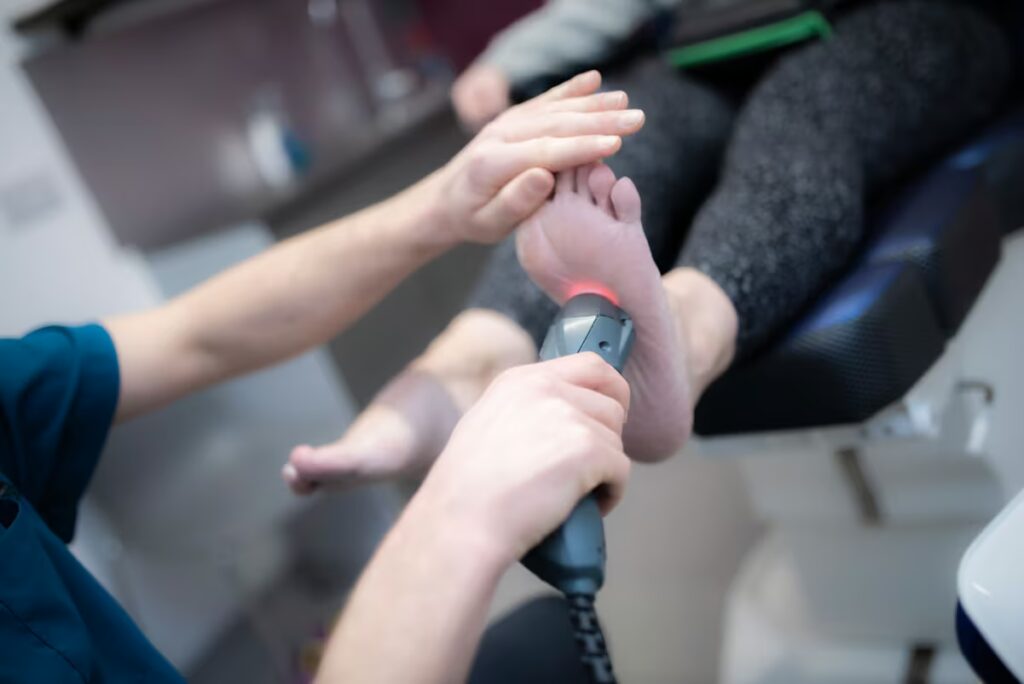
What happens at your assessment
1. We take a history.
Your training, what changed before it started, your shoes, and what you're aiming at.
2. We examine the tendon
And work out exactly where it hurts.
3. We test your calf properly,
Usually by asking you to do single leg heel raises to fatigue, which tells us far more than a strength test by hand.
4. We scan where useful,
To confirm the diagnosis and check for tearing.
5. We give you a loading programme
Matched to the type you have, with the numbers written down.
How we treat Achilles tendinopathy
- Progressive loading. Tendon responds to load, and this is the part of treatment that matters most. It's slow and it's specific.
- Shockwave therapy, for tendons that have stalled. We treat the tendon and the calf at every appointment, usually about six appointments over around eight weeks, a week apart.
- MLS laser therapy, to settle pain while loading gets under way.
- Heel raises and footwear changes, which take immediate tension off an insertional problem.
- Orthotics, where foot position is adding to the load.
- Soft tissue work, for the calf rather than the tendon itself.
- Activity planning. You usually don't need to stop running. You need to run differently for a while.
Prices
Appointment
Length
Price
Ultimate MSK (full assessment plus Run3D gait analysis)
90 minutes
£295
Pain & Injury Assessment
60 minutes
£165
Pain & Injury Follow-up (shockwave, laser or acupuncture)
30 minutes
£85
Ultrasound and assessment, with Adam
45 minutes
£195
Insoles and custom orthotics
30 minutes
£80 to £250
Frequently asked questions
Should I stop running?
Usually not. Most people can keep running at a reduced level, and continuing with the right load generally works out better than stopping and starting again.
Why does it feel better once I'm warmed up?
Tendon tolerates load better once it's warm. It's not a sign the problem has gone, and the pain the following morning is the better guide to whether you did too much.
How long will it take?
Tendons are slow to change. A typical shockwave course is about six appointments over around eight weeks, alongside a loading programme that usually carries on for a few months. We'll give you our honest estimate at your first appointment.
Is stretching good for it?
For mid-portion, sometimes. For insertional, aggressive calf stretching often makes it worse by compressing the tendon against the heel bone. This is one of the reasons the two need telling apart.
Can it rupture?
Tendinopathy itself doesn't usually lead to rupture, but a tendon with significant change on a scan is worth knowing about. That's part of why we scan.
If your Achilles has been sore for more than a few weeks, get it looked at before the season you're training for.