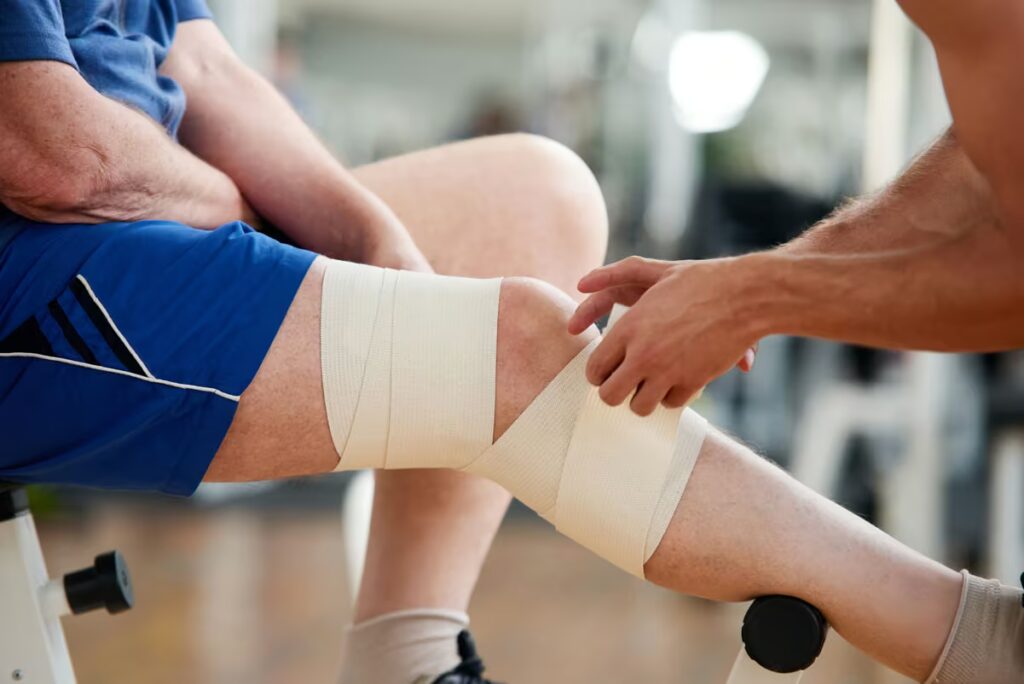
Knee Pain and Runner's Knee
Plenty of knee pain has nothing to do with the knee. The joint sits between the foot and the hip and takes the consequences of what both of them do. If your knee pain hasn't responded to treatment aimed at the knee, this is often why. What people come in with:- Pain around or behind the kneecap, worse on stairs and after sitting
- Pain on the outside of the knee that appears at a predictable point in a run
- Aching after activity rather than during it
- A knee that feels like it gives way or catches
- Pain that started when training increased or shoes changed
The common causes we see
- Patellofemoral pain (runner's knee), around the kneecap, usually a loading and control problem rather than damage.
- Iliotibial band syndrome, felt on the outside of the knee, common in runners and often linked to hip control and foot mechanics.
- Patellar tendinopathy, below the kneecap, common in jumping and change-of-direction sports.
- Early knee osteoarthritis, where loading changes can make a real difference to symptoms.
Why a podiatrist for knee pain
Because the foot affects how force arrives at the knee. A foot that rolls in excessively rotates the shin, which changes how the kneecap tracks. A stiff ankle changes how you absorb landing. Neither shows up if you only look at the knee.We measure it in three dimensions.
Run3D uses 39 reflective markers and infrared cameras recording 200 times a second, was developed by scientists at the University of Oxford, and compares your movement against a database of uninjured runners. It captures the rotation that ordinary video can't. We're the only Run3D clinic in Edinburgh and the Lothians.We scan the soft tissue around the knee where it helps.
We treat both ends.
Orthotics change what arrives at the knee. Strength work changes what the knee can tolerate. You usually need both.We work alongside physiotherapy rather than instead of it,
And we'll say so when that's what you need.We see a lot of it in sport.
We're podiatrists to Hibernian FC, and runners and footballers make up a big part of our week.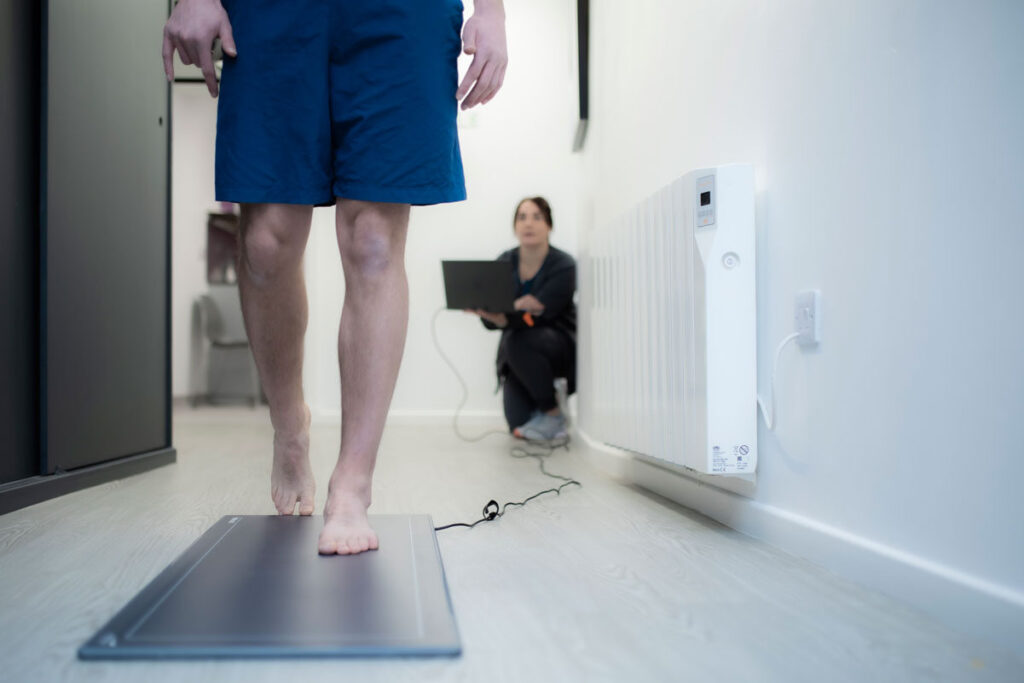
What happens at your assessment
Step 1
We take a full history, including training, footwear and what changed.
Step 2
We examine the knee, the hip and the foot, because the answer is often not where the pain is.
Step 3
We test strength and single leg control.
Step 4
We analyse your gait, with pressure analysis and, in an Ultimate MSK appointment, Run3D 3D motion capture.
Step 5
We scan where it will change the plan.
Step 6
We give you a written plan, with what we treat and what you do.
How we treat knee pain
- Targeted strength work, usually hip and quadriceps, the main treatment for pain around the kneecap.
- Orthotics, where the foot is driving rotation into the knee.
- Footwear changes.
- Gait retraining, where the data shows something specific worth changing. Small changes to cadence or foot strike can reduce the load on the knee.
- Shockwave therapy, for patellar tendinopathy.
- MLS laser therapy, to manage pain while the loading work progresses.
- Soft tissue therapy and joint mobilisation.
- Load management, so you keep training rather than stopping.
Prices
Appointment
Length
Price
Ultimate MSK (full assessment plus Run3D gait analysis)
90 minutes
£295
Pain & Injury Follow-up (shockwave, laser or acupuncture)
30 minutes
£85
Ultrasound and assessment, with Adam
45 minutes
£195
Insoles and custom orthotics
30 minutes
£80 to £250
Frequently asked questions
Should I see a podiatrist or a physio?
Often both, and it depends where the problem starts. If your knee pain is linked to running, footwear or foot mechanics, start here. If we think you need physiotherapy, we'll tell you.
Can orthotics really help knee pain?
They can help some types of knee pain, particularly pain around the kneecap. They're not a universal answer, which is why we measure first.
Do I need to stop running?
Usually not. Most knee pain in runners responds better to modified training than to complete rest.
What is runner's knee?
A general term, usually meaning patellofemoral pain. It describes where it hurts rather than being a diagnosis.
Is my knee pain arthritis?
In younger and active people, usually not. Where there is arthritis, loading changes can still make a real difference.
How long until it improves?
Pain around the kneecap often improves over a couple of months of the right strength work. Tendon problems take longer. We'll give you our estimate at your assessment.
If your knee has been treated as a knee problem and hasn't improved, it's worth measuring what your feet and hips are doing.