Ankle Pain and Sprains
Most of the ankles we see belong to people who sprained one years ago, were told to rest it, and never got it properly rehabilitated. It's been slightly unreliable ever since. What people come in with:- An ankle that keeps giving way on uneven ground
- Pain on the outside of the ankle after an old sprain
- Swelling that returns whenever you do too much
- Stiffness first thing, or after sitting
- Pain at the front of the ankle when you squat or go uphill
- A deep ache in the joint that has come on gradually with no injury


What causes ankle pain?
- Ligament injury that never fully healed. The most common story by far. Many ankle sprains leave lasting symptoms, usually because the rehabilitation stopped when the pain did.
- Tendon problems, particularly the peroneal tendons on the outside and tibialis posterior on the inside.
- Impingement, where tissue or bone pinches at the front or back of the joint, typically felt at the end of the movement.
- Early arthritis in the joint, more common after a significant previous injury.
- Loading problems from elsewhere, from the foot below or the hip above.
Why come to us for an ankle
We scan it.
Ultrasound shows ligaments and tendons in real time, and we can scan while moving the joint, which static imaging can't do.We treat the reason it keeps happening.
An ankle that gives way has usually lost its balance and position sense, not just its ligament strength, and that's trainable.We look at what's underneath it.
A foot that loads badly puts the ankle in a vulnerable position hundreds of times a day.We can measure it moving.
Run3D captures ankle movement in three dimensions, including rotation, which is exactly where ankle problems live.We see a lot of it in sport.
We're podiatrists to Hibernian FC, and sprained ankles are part of every football season.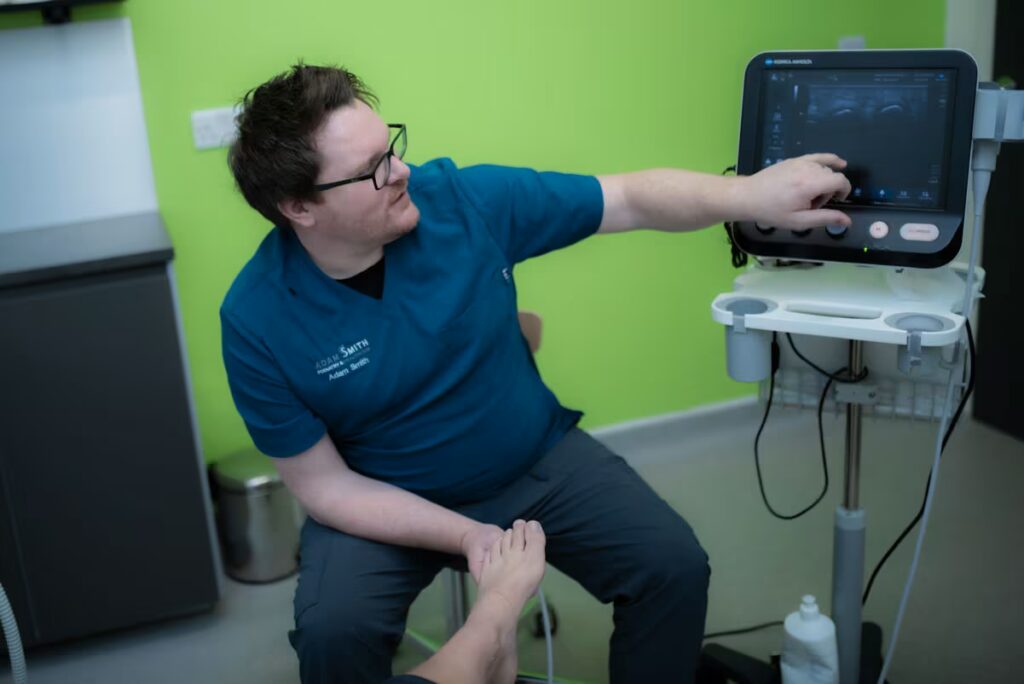
What happens at your assessment
Step 1
We take the history, including any injury however long ago.
Step 2
We test the ligaments, the tendons and the joint's range.
Step 3
We test your balance and single leg control, which is usually where the problem shows up.
Step 4
We scan where it will change the plan.
Step 5
We assess your walking, and your running where relevant.
Step 6
We build a rehabilitation plan with progressions.
How we treat ankle pain
- Balance and control work. This is the part that stops it giving way, and it's the part most people never did after their original sprain.
- Strength work for the muscles that support the ankle.
- Joint mobilisation, where stiffness is limiting movement.
- Soft tissue therapy for the surrounding structures.
- Shockwave or laser therapy for tendon problems that have persisted.
- Orthotics, where foot position is putting the ankle at a disadvantage.
- Onward referral where a scan suggests something that needs a surgical opinion.

Prices
Appointment
Length
Price
Ultimate MSK (full assessment plus Run3D gait analysis)
90 minutes
£295
Pain & Injury Follow-up (shockwave, laser or acupuncture)
30 minutes
£85
Ultrasound and assessment, with Adam
45 minutes
£195
Insoles and custom orthotics
30 minutes
£80 to £250
Frequently asked questions
I sprained it two years ago. Is it too late?
No. Ankles respond to proper rehabilitation long after the original injury, because the problem is usually control rather than damage.
Why does it keep giving way?
Ligaments contain the nerve endings that tell your brain where your foot is. After a sprain that feedback is impaired, so the ankle is slower to react. It's retrainable.
Do I need an X-ray or MRI?
Usually not to begin with. Ultrasound answers most questions about soft tissue, and we'll refer you on if we think you need more.
Should I wear a brace?
Short term after an injury, or for return to sport, sometimes. Long term it tends to mask the problem rather than sort it.
How long does rehabilitation take?
For an ankle that keeps giving way, usually a couple of months or more of regular work, and it depends on that work actually getting done. We'll give you our estimate at your assessment.
If you still think twice before stepping on uneven ground, that ankle isn't finished healing.